



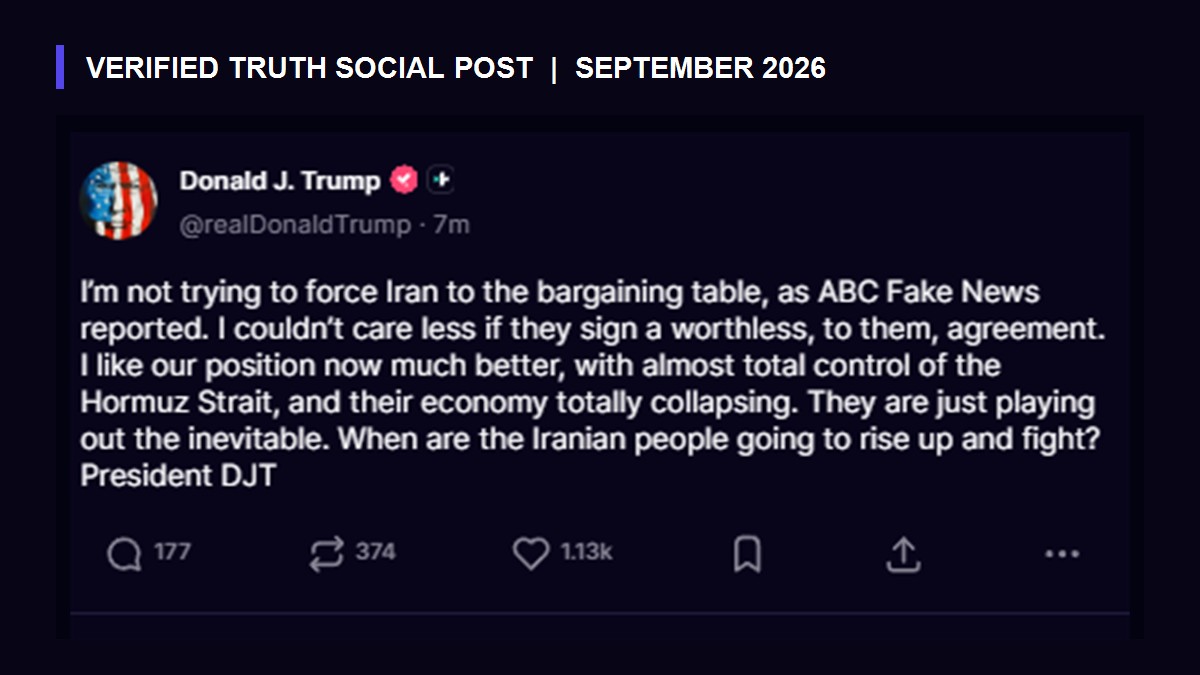
US President Donald Trump has sharpened his public message toward Iran, saying he is not trying to force Tehran back to negotiations and asking when Iranians will “rise up and fight.” The comments, posted on his verified Truth Social account after renewed US strikes, are authentic. Several of the factual claims wrapped around them, however, require qualification.
The verified statement
In the Truth Social post reported on 2 September, Trump rejected the idea that the latest US military pressure was designed simply to bring Iran back to the bargaining table. He said he “couldn’t care less” whether Tehran signed what he called a worthless agreement, argued that Washington’s position had improved, claimed “almost total control” of the Strait of Hormuz and said Iran’s economy was collapsing. He ended by asking when the Iranian people would “rise up and fight.”
The existence and wording of the post are corroborated by CBS News, Forbes, The Times of Israel and subsequent remarks Trump made to reporters. This is therefore not a fabricated social-media quote.
What happened militarily
The statement followed the largest exchange of fire between the United States and Iran since July. US Central Command said American forces struck Islamic Revolutionary Guard Corps targets, including air-defence sites, radar systems, maritime facilities, mine-laying capabilities and communications sites. Trump told reporters that the operation had hit equipment near the Strait of Hormuz and said further action remained possible.
Iran had fired missiles toward US bases in Jordan and was accused by Washington of attempting to place mines in the strait. The precise operational effect of the strikes—and competing claims about interception rates, casualties and target damage—cannot be fully established from public information. Both governments have a strong incentive to portray their own actions as successful and the other side as weakened.
Fact-check: “almost total control” of Hormuz
The United States has overwhelming naval power in the region and can conduct surveillance and strikes around the Strait of Hormuz. That does not automatically mean uncontested legal or physical control of the waterway. Commercial shipping levels, insurance costs, naval warnings, Iranian enforcement activity and the ability of vessels to transit safely are better measures than political language.
Reporting by the Associated Press indicates that shipping remains well below normal levels even as Washington claims control. Iran retains missiles, drones, mines and coastal capabilities that can threaten traffic. The most accurate assessment is that the US has a dominant military presence, while the strait remains contested and commercially disrupted. Trump’s “almost total control” formulation is a political and military claim, not a settled independent fact.
Fact-check: Iran’s economy and inflation
Iran’s economy is under severe pressure from war, sanctions, disrupted trade, currency weakness and uncertainty around oil exports. Independent reporting supports the broad claim of deep economic distress. But specific figures repeated in political speeches—such as claims of 300% or 350% inflation—should not be treated as verified without a defined period, methodology and reliable statistical source.
Inflation can be measured as an annual consumer-price rate, a monthly rate, food inflation or a change in the exchange value of the currency. Those are not interchangeable. “Economic collapse” is also a judgment rather than a technical indicator. Iran faces an acute crisis; the exact scale is harder to establish in real time.
Fact-check: the call to “rise up”
Trump did ask Iranians when they would “rise up and fight.” When questioned in the Oval Office about whether the CIA would arm opposition forces, he declined to discuss covert action. He also cited extremely high protester-death estimates. Those casualty numbers have not been independently verified to a standard that would justify presenting them as established fact.
The distinction matters. Confirming that a president made a statement is different from confirming every assertion inside it. Calls for popular revolt can carry serious consequences for civilians, especially when there is no clear public commitment concerning protection, assistance or the political outcome Washington would support.
Why the verified screenshot matters
The featured image is a genuine screenshot of the specific Truth Social post analysed in this report. It shows Trump’s verified @realDonaldTrump account and the complete statement about negotiations, the Strait of Hormuz, Iran’s economy and his call for Iranians to “rise up and fight.” The post is independently preserved by the American Presidency Project and corroborated by Reuters, CBS News and other news organisations.
Screenshot source: Donald J. Trump’s verified Truth Social account, archived by OSINT613. It is reproduced here for reporting, verification and commentary.
Risks for the region and India
The Strait of Hormuz is one of the world’s most important energy corridors. Any prolonged disruption can affect crude-oil and liquefied-natural-gas prices, shipping insurance and freight costs. India is particularly exposed through energy imports, trade routes and the welfare of Indian citizens across Gulf countries.
There is also a risk of escalation through miscalculation. A mine incident, a missile that causes mass casualties or an attack attributed to the wrong actor could widen the conflict before political leaders have time to contain it. Strong rhetoric on social media can intensify that danger when it narrows room for compromise or creates expectations of immediate retaliation.
HMP verdict
- Authentic: Trump’s Truth Social statement dismissing the value of negotiations and asking when Iranians would “rise up and fight.”
- Confirmed in broad terms: renewed US strikes on Iranian military-related targets and serious pressure on Iran’s economy.
- Needs qualification: “almost total control” of Hormuz. US military dominance is clear, but commercial movement remains disrupted and Iranian threats have not disappeared.
- Not independently established: precise inflation and protester-death figures cited by Trump.
- Assessment: the statement represents a harder public posture, but it is not proof that diplomacy has ended or that the US has achieved uncontested control of the strait.