



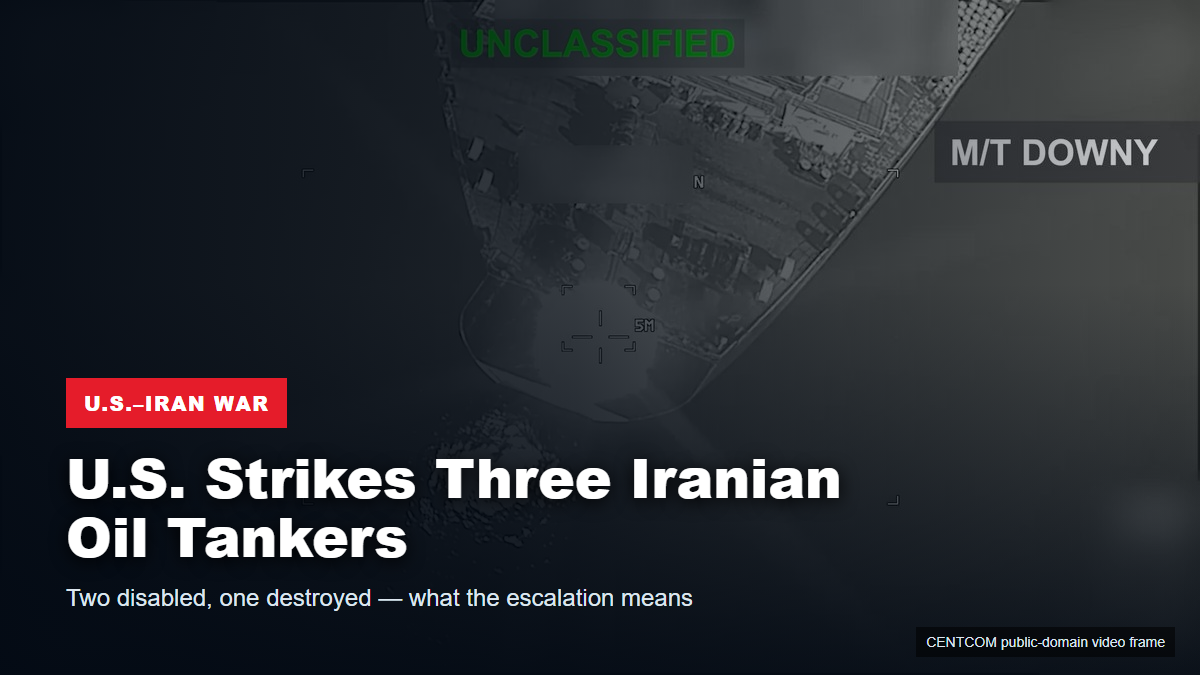
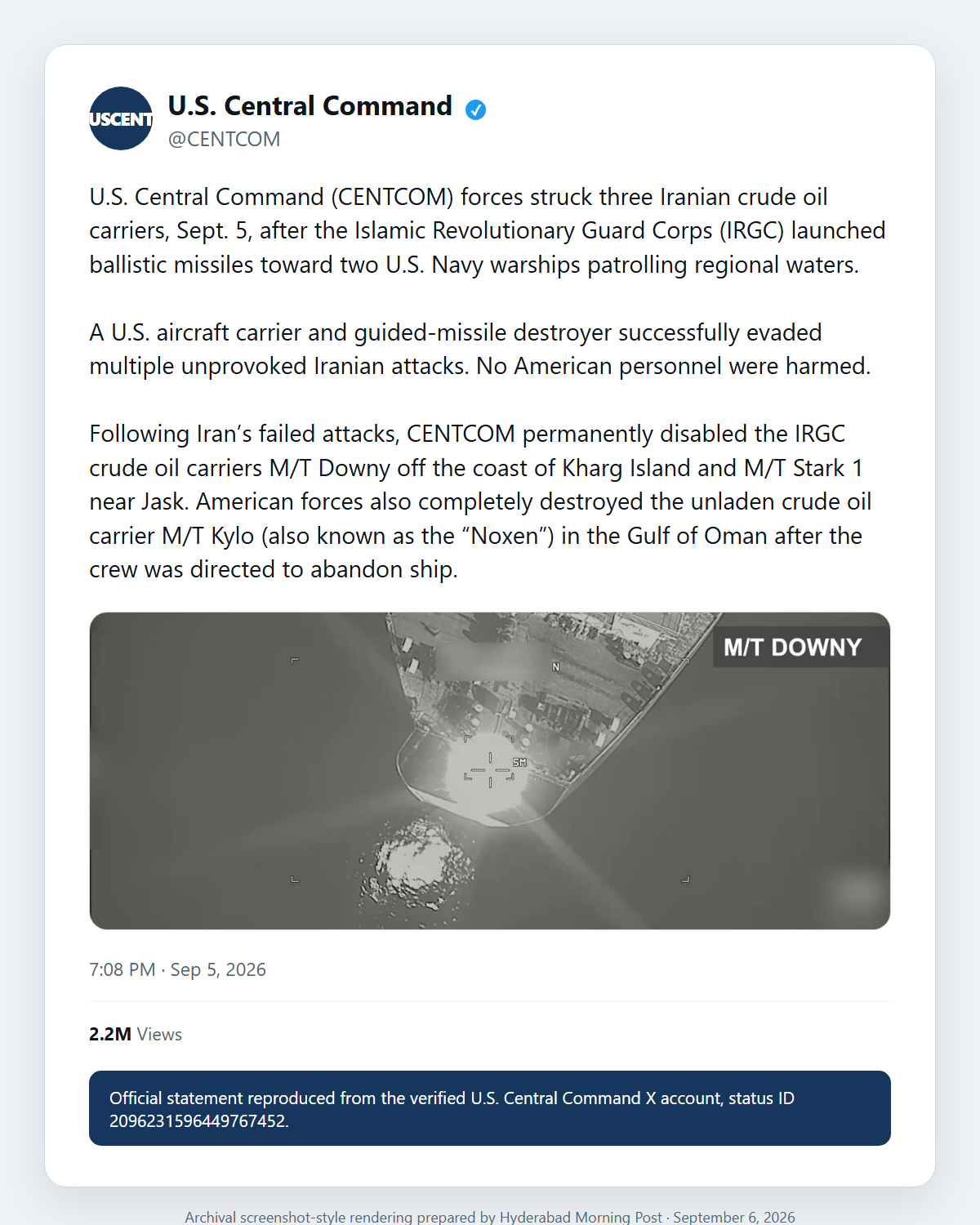
U.S. forces struck three Iranian crude-oil tankers on September 5 after Iran’s Islamic Revolutionary Guard Corps launched ballistic missiles toward two American warships, according to U.S. Central Command. CENTCOM said two vessels were permanently disabled and a third, which was empty, was completely destroyed.
The strikes mark a sharp escalation in the six-month conflict between the United States and Iran because they move the confrontation deeper into the infrastructure that generates and transports Iranian oil revenue. Until now, attacks at sea had already threatened commercial shipping; directly targeting named crude carriers brings military retaliation, economic warfare and global energy security into the same battlefield.
CENTCOM identified the vessels as the M/T Downy, struck off Kharg Island; the M/T Stark 1, hit near Jask; and the M/T Kylo, also known as Noxen, attacked in the Gulf of Oman. The command said Downy and Stark 1 were “permanently disabled”. It described Kylo as an unladen—or empty—crude carrier and said the crew was directed to abandon the ship before American forces struck it in multiple critical locations.
What happened on September 5?
According to the American account, an aircraft carrier and a guided-missile destroyer were operating in regional waters when the IRGC launched multiple ballistic missiles toward them. CENTCOM said both ships evaded the attacks and no American personnel were injured.
Iranian state television separately reported that American missiles struck a tanker roughly 10 kilometres from Kharg Island, the hub through which most Iranian crude exports pass. After the U.S. announcement, Iranian reporting acknowledged attacks involving the other vessels and said crews had evacuated.
These parallel accounts confirm the central fact that three tankers were attacked, but important details still come primarily from the belligerents. There is no independently published damage survey, satellite assessment or complete crew manifest for all three ships. Claims about ownership, cargo, operational status and precise weapon effects should therefore remain attributed rather than treated as independently established.
Were all three tankers destroyed?
No—not according to CENTCOM’s own precise wording. The command said Downy and Stark 1 were permanently disabled, while Kylo/Noxen was completely destroyed. Headlines that say the United States “destroyed three tankers” capture the overall military action but blur a meaningful distinction.
A disabled tanker may be unable to sail or load cargo without extensive repairs, but that does not necessarily mean it sank or was physically destroyed. Kylo, by contrast, was reportedly struck multiple times after evacuation. CENTCOM said it was not carrying crude at the time, reducing—but not eliminating—the risk of a major oil spill because even an empty tanker carries fuel, lubricants and residues.
That distinction matters for casualty estimates, environmental consequences, insurance claims and any calculation of Iran’s economic loss. HMP is using “U.S. strikes three tankers; two disabled, one destroyed” because it most accurately reflects the currently available evidence.
Why did the United States target oil carriers?
CENTCOM characterised the vessels as part of a multibillion-dollar “shadow network” that finances the IRGC and regional armed groups. Iran has long used complex ownership structures, flag changes, ship-to-ship transfers and opaque trading arrangements to move sanctioned oil.
The American rationale is therefore both retaliatory and economic. The immediate justification was the alleged missile attack on two warships; the chosen response sought to impose a cost on Iran’s ability to earn and transport oil revenue. CENTCOM commander Admiral Brad Cooper framed it explicitly as a disproportionate economic response: two U.S. ships targeted, three Iranian ships taken out of service.
This represents a more aggressive extension of the “tanker-for-tanker” approach reported earlier in the conflict. Rather than confining retaliation to missile launchers or radar sites, Washington is signalling that attacks on naval or commercial shipping can produce direct losses to Iran’s oil fleet.
Why Kharg Island changes the risk
Kharg Island is the centre of Iran’s crude-export system. It lies in the Persian Gulf off Iran’s coast and handles the overwhelming majority of the country’s seaborne oil exports. A strike close to the island does not mean the terminal itself was attacked, but it demonstrates that military operations are occurring immediately beside strategically vital energy infrastructure.
That proximity raises the danger of miscalculation. Iran could interpret repeated attacks near Kharg as preparation for a broader campaign against export facilities. The United States could interpret further Iranian missile or drone launches as justification for expanding the target set. Each side may believe limited retaliation will restore deterrence; together, those actions can create an escalation cycle neither side fully controls.
What does this mean for oil prices and shipping?
The immediate market concern is not the volume carried by three vessels. Global oil markets can absorb the temporary loss of several tankers. The larger risk is whether insurers, shipowners and crews begin treating the Persian Gulf and Gulf of Oman as zones where commercial-sized vessels may be deliberately targeted.
War-risk insurance premiums can rise rapidly after a maritime attack. Operators may delay voyages, demand higher freight rates or reroute when possible. The Strait of Hormuz cannot be easily bypassed for much of the Gulf’s production, so even the perception of danger can affect prices before any physical shortage emerges.
A sustained campaign against tankers would also complicate sanctions enforcement. Ships accused of serving a shadow fleet may be treated as military-economic targets by one side while remaining commercial property under another legal interpretation. That uncertainty makes ports, crews, financiers and insurers more cautious.
The legal and humanitarian questions
CENTCOM says the tankers financed a military organisation and that its strikes followed attacks on American naval vessels. Iran can be expected to describe the action as unlawful aggression against civilian economic assets. The legality of attacking a commercial vessel during armed conflict depends on facts including ownership, use, cargo, contribution to military action, warning, proportionality and precautions taken to protect crews.
The reported order for Kylo’s crew to abandon ship is relevant to civilian protection, but it does not by itself settle the legal question. Nor does labelling a vessel part of a “shadow fleet” automatically establish that it is a lawful military objective. A credible assessment requires more evidence than either side has publicly released.
There were no immediate confirmed reports of American casualties from the preceding missile launches. Initial Iranian reporting said tanker crews evacuated, but comprehensive information about injuries and environmental damage was not yet available.
How might Iran respond?
Iran has several possible responses, each carrying different risks. It could launch further missiles or drones at U.S. military assets; target shipping linked to American allies; use regional partners to widen pressure; attempt cyber operations; or avoid immediate escalation while seeking diplomatic leverage.
Direct attacks on U.S. warships would be the most dangerous pathway because they could produce casualties and trigger a much larger American response. Pressure on commercial shipping may offer Iran a way to impose global economic costs, but it would also risk alienating countries that depend on Gulf energy flows.
Tehran’s public response and its operational decisions may diverge. Strong rhetoric can serve domestic and deterrent purposes while commanders choose a more limited action. Conversely, decentralised or proxy activity can escalate faster than official statements suggest.
Why the escalation matters to India
India imports most of the crude oil it consumes and remains highly exposed to changes in global prices and shipping costs. A prolonged threat to Gulf maritime traffic could increase India’s import bill, weaken the rupee, raise transport and manufacturing costs and complicate inflation management.
Indian nationals also work throughout the Gulf and aboard international merchant vessels. New Delhi will therefore watch crew safety, evacuation planning and freedom of navigation alongside the energy-market impact.
India’s diplomatic challenge is to protect commercial interests without becoming drawn into the strategic positions of either side. Maintaining contact with Washington, Tehran and Gulf capitals will be essential if the conflict threatens shipping lanes or energy supplies.
What to watch next
The most important indicators are whether Iran retaliates at sea, whether U.S. forces strike additional tankers or oil infrastructure, and whether traffic near Kharg Island and the Strait of Hormuz slows. Satellite imagery and maritime tracking may clarify the condition of the three vessels, while official casualty and pollution assessments could change the picture.
For now, the verified conclusion is narrower than some viral claims: U.S. forces attacked three named Iranian crude carriers; CENTCOM says two were permanently disabled and the empty third vessel was destroyed after evacuation. The strategic consequence, however, is broad. Oil transport itself has become an explicit instrument and target in the U.S.–Iran confrontation.
Read HMP’s earlier analysis of President Trump’s Iran message and follow our Middle East coverage for verified updates.
Verification note: HMP cross-checked the strike announcement against the verified CENTCOM X post, CENTCOM-released video, Iranian state-media reporting and independent coverage. Operational and damage claims attributed to CENTCOM have not all been independently verified.